
Self-Worth, Anxiety & Relationship Patterns Therapy in Florida

Category: Control

When You Learn to Read the Room: How Childhood Experiences Shapes Adult Relationships

Some children learn to read the room before they learn to read words. They notice the sigh before the argument, the silence before the storm, the subtle shift in tone that means something is wrong. They adapt quickly, quietly, and often voluntarily not necessarily because anyone told them to, but because it made things feel safer.

“If I can anticipate someone’s mood, I can prevent something bad from happening.” “If I know when someone is upset, I can adjust myself.” “If I keep everyone emotionally regulated, things feel safer.”

For some children, this is where emotional responsibility begins. For others, emotional monitoring itself becomes a way of staying safe. Either way, the child learns that paying close attention to other people’s emotions can help create a sense of predictability or security.


The Origins of Emotional Monitoring

Emotional monitoring is the habit of constantly scanning other people’s moods, reactions, and emotional states in order to anticipate what might happen next. When a child learns that the emotional climate around them can change quickly, paying attention becomes a way of staying prepared.

For some, this pattern begins in environments where emotions are unpredictable, conflict is frequent, or the child has experienced frightening or traumatic situations. For others, it develops through inconsistent caregiving, emotional unavailability, or unmet emotional needs. A child may also become highly attuned to others when they are expected to soothe, support, or manage a parent’s emotions.

Sometimes there is no obvious crisis. A child may simply learn that staying attuned to other people’s moods helps maintain connection, reduce tension, or avoid disappointment. What begins as adaptation can eventually become a deeply ingrained way of relating to others.

This adaptation can look mature, empathic, or even gifted.  But underneath, it can involve a level of vigilance that makes it difficult to simply be present in relationships.


The Child Who Reads the Room

The child who learns to read the room can become the family’s emotional thermostat.  They learn to sense when someone is irritated before anyone says it. They notice subtle changes in tone, posture, or silence. They replay conversations to see if they caused distress. They adjust their personality depending on who they are with. They take on the invisible job of keeping everyone emotionally comfortable.

This is not about attention‑seeking. It is about safety. When the emotional climate feels unpredictable, the child’s nervous system learns that stability depends on their awareness and response.


How It Shows Up in Adulthood

That early vigilance often becomes a relational reflex. You may:

  • Notice subtle changes in someone’s tone immediately
  • Overanalyze texts and facial expressions
  • Sense irritation before anyone says it aloud
  • Immediately wonder, “Did I do something?”
  • Replay conversations looking for signs you upset someone
  • Feel uneasy when someone is quiet
  • Assume a change in mood has something to do with you
  • Try to fix tension before anyone asks you to
  • Overthink what to say to avoid triggering a reaction
  • Feel responsible for keeping interactions comfortable
  • Struggle to relax around emotionally unpredictable people
  • Automatically adjust your personality depending on who you’re with
  • Lose track of your own feelings because you’re focused on everyone else’s
  • Mistake awareness of someone’s emotions for responsibility for their emotions

This pattern can overlap with parentification and relational guilt. Parentification describes a childhood role in which a child takes on responsibilities that belong to adults. Relational guilt can involve feeling responsible for other people’s emotions, comfort, or reactions. Emotional monitoring can connect with both when a child learns to constantly scan, anticipate, and adjust to the emotional environment around them.


The Cost of Constant Awareness

Emotional monitoring can make relationships feel like performance. You may feel like you are always managing the emotional temperature, always adjusting, always preventing something. It can lead to exhaustion, anxiety, and difficulty trusting that others can handle their own emotions.

You might confuse empathy with responsibility. You might believe that noticing someone’s discomfort means you must fix it. You might feel guilty for relaxing when others are tense. You might struggle to identify your own feelings because your attention is always outward.

This may look like a boundary problem in adulthood, but underneath it can be a learned reflex.


The Therapeutic Shift

The goal is not to become less caring or less perceptive. It is to recognize that noticing something does not automatically make it yours to manage.

You can notice someone’s mood without taking responsibility for it. You can sense tension without needing to fix it. You can care about someone’s feelings without absorbing them.

This shift is subtle but profound. It teaches your body that safety no longer depends on managing everyone else’s emotional state. It allows empathy to coexist with boundaries. It transforms vigilance into attunement.


Relearning Emotional Safety

In therapy, this often looks like:

  1. Recognizing the pattern Naming emotional monitoring helps you see it as adaptation, not identity.
  2. Rebuilding internal permission You are allowed to notice without intervening. You are allowed to rest even when others are uneasy.
  3. Practicing emotional neutrality When someone’s mood changes, pause before assuming it is about you. Ask yourself, “What am I noticing, and what am I assuming?” Then ask, “Is this mine to carry?”
  4. Reconnecting with your own feelings Awareness of others often comes at the cost of awareness of self. Healing restores that balance.
  5. Learning to tolerate tension Discomfort does not always mean danger. Sometimes it is simply difference.

Final Thoughts

Emotional monitoring is a skill born from necessity. It kept you safe when safety depended on emotional awareness. But now, it may keep you anxious when safety depends on self‑trust.

You can still read the room; you just do not have to hold it together. You can still care deeply; you just do not have to carry it all. You can still be attuned; you just do not have to be responsible.

The goal is not to stop noticing. It is to stop absorbing.
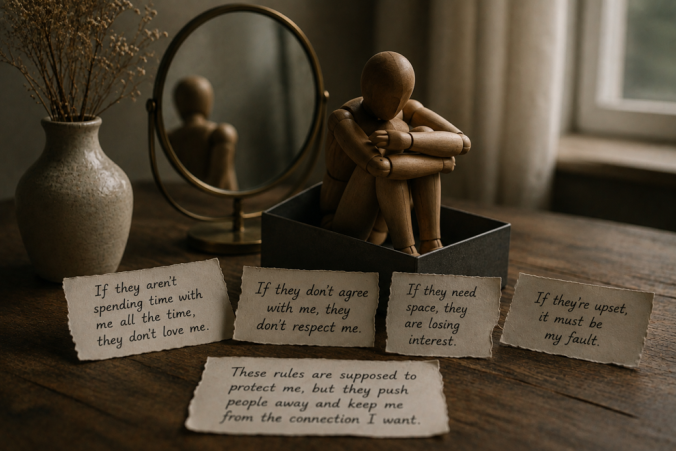
When Fear Becomes Self‑Sabotage: How Rigid Internal Rules Quietly Shape Relationships

Most people don’t sabotage relationships because they don’t care.  Often, they sabotage because they’re scared of being hurt, rejected, dismissed, or misunderstood. Over time, those fears can solidify into rigid internal rules that feel like truth, even when they quietly undermine connection.

These rules often operate beneath awareness. They show up as emotional reactions that feel justified in the moment but create distance, conflict, or confusion in relationships.

This isn’t about being “too sensitive” or “too much.” It’s about carrying old insecurities and wounds into new relationships and trying to protect yourself in ways that no longer serve you. These patterns come from places where you once felt uncertain, unseen, or unprotected, and they continue to shape how you interpret discomfort in the present.


The Emotional Logic Behind Self‑Sabotage

Self‑sabotage is rarely intentional. It’s usually a protective strategy shaped by past experiences, unmet needs, or relational wounds.

Common drivers include:

  • Insecurity: needing reassurance to feel valued or safe
  • Hypervigilance: scanning for signs of disrespect or rejection
  • Fear of abandonment: interpreting neutral behavior as pulling away
  • Intolerance of discomfort: needing immediate relief from uneasy feelings
  • Black‑and‑white thinking: small issues feel like major relational threats

These patterns often develop because they once helped you feel emotionally safer. They offered clarity, control, or protection in moments when you didn’t have better tools.


Rigid Rules That Create Relationship Conflict

Here are some of the most common internal rules people follow without realizing it, and how they can quietly interfere with connection

1. “If I feel uncomfortable, something must be wrong.”

A moment of insecurity becomes a certainty. Instead of exploring the feeling, the discomfort gets projected outward:

  • “You must have done something.”
  • “You’re hiding something.”
  • “You don’t care enough.”

This creates conflict where communication was needed.

2. “If I’m not reassured, I’m not valued.”

Reassurance becomes evidence that the relationship is safe and that you matter. Without it, uncertainty can quickly become a conclusion: Something has changed. They don’t feel the same. I’m not important to them.

Partners often feel pressure to provide constant reassurance, which can strain the relationship.

3. “If someone needs space, they’re pulling away.”

Neutral behaviors such as alone time, time with friends or slower replies get interpreted as rejection or disrespect.  The behavior itself may be neutral. The meaning assigned to it is what creates the emotional reaction.

This can lead to:

  • arguments
  • accusations
  • emotional spiraling
  • testing the relationship

4. “If something feels off, I should withdraw.”

Discomfort becomes a cue to shut down, pull back, or stop talking altogether.

This protects you from vulnerability, but it also prevents repair, clarity, and deeper connection.

5. “If I feel insecure, someone else needs to make me feel better.”

The emotional responsibility gets placed on the other person:

  • “Make me feel better.”
  • “Prove you care.”
  • “Show me I matter.”

This can create an exhausting cycle in which reassurance temporarily eases the insecurity without addressing what is underneath it.


Why These Patterns Are Hard to Break

Because they work, at least temporarily.

  • Withdrawal can reduce vulnerability.
  • Reassurance can reduce anxiety.
  • Accusations can create a temporary sense of certainty.
  • Testing can temporarily answer the question you’re afraid to ask directly.

The problem is that short-term relief can reinforce long-term patterns.

  • loneliness
  • instability
  • relationship fatigue
  • cycles of conflict and repair
  • guilt for reacting in ways you didn’t intend

Most people don’t realize they’re following rules. They only see the reaction, not the belief underneath it.


How to Interrupt the Pattern

These shifts help you respond rather than react.

1. Name the rule

Identify the belief driving the reaction:

  • “Discomfort means danger.”
  • “Space means rejection.”
  • “Reassurance equals worth.”

Naming the rule gives you more choice in how you respond to it.

2. Pause before acting

Create a small gap between the feeling and the response.  Even a brief pause between the feeling and the response can change the outcome.

3. Check the story

Ask yourself:

  • “Is this fear or fact?”
  • “Is there another explanation?”
  • “What else could be true?”

This helps soften rigid interpretations.

4. Communicate the insecurity instead of the accusation

Instead of:

  • “You don’t care.”
  • “You’re pulling away.”
  • “You’re disrespecting me.”

Try:

  • “I’m feeling insecure right now.”
  • “I need some clarity.”
  • “Can we talk about this?”

This invites connection instead of conflict.

5. Build tolerance for discomfort

Practice staying present with uneasy feelings without acting on them immediately. Notice the feeling, name it, and allow it to exist without needing to resolve it right away. You don’t have to share it with your partner the moment it shows up. Sometimes the most powerful shift is doing the opposite of what the insecurity tells you to do.

For example, if you feel jealous or uneasy when your partner spends time with a friend or family member, instead of withdrawing or assuming something is wrong, you might choose to stay curious and connected. You could ask, “Did you have a good time with them?” or “How was your day?”

This doesn’t mean ignoring your feelings. It means observing them without letting them dictate your behavior and choosing a response that supports connection rather than fear.

6. Strengthen internal reassurance

Shift from “I need you to make me feel okay” to “I can soothe myself first, then communicate.”

7. Practice repair instead of withdrawal

Returning to the conversation, even after pulling back, builds relational resilience.


Final Thoughts

Self‑sabotage rooted in fear, insecurity, and past relational wounds isn’t a sign of being broken or dramatic. It may be a sign that you’ve carried emotional burdens alone for a long time and learned to protect yourself in ways that made sense at the time.

These patterns don’t define your capacity for healthy relationships. They can reveal where greater awareness, self-compassion, and healing may still be needed

Change begins with awareness, compassion, and small moments of choosing connection over fear. You don’t have to be perfect. You just have to be willing to understand yourself more gently.

If you recognize yourself in these patterns, therapy can offer a space to understand where these beliefs came from, develop greater emotional flexibility, and build healthier ways of responding in relationships.

You don’t have to navigate those patterns alone.

Interrupting the ADHD Stress Cycle: How to Work With Your Brain Instead of Fighting It

Many people with ADHD find that their attention and motivation are strongly influenced by interest, novelty, urgency, and emotional salience, rather than importance alone. When an interest-driven brain is expected to operate in an importance-driven world, a predictable stress cycle can develop.

Understanding this cycle is the first step toward interrupting it with compassion rather than criticism.


The ADHD Stress Cycle Begins With “Hard Starts”

ADHD makes it difficult to initiate tasks that don’t spark interest. Even simple responsibilities like answering an email, returning a voicemail, folding laundry, paying a bill can feel like pushing against a current. This isn’t laziness. It’s a neurological mismatch between what the brain needs to activate and what life demands.

When the task doesn’t get started, stress begins to rise.


Stress Turns Into Shame

For many people with ADHD, the stress cycle doesn’t just come from inside. It’s reinforced by the world around them. When a task feels hard to start or finish, the internal dialogue often begins:

  • “Why can’t I just do this?”
  • “Other people don’t struggle like this.”
  • “I should be better at this.”

But the shame doesn’t stop there.   People who experience ADHD-related challenges frequently absorb external criticism as well, sometimes subtle, sometimes direct:

  • “You’re so smart, why can’t you just focus?”
  • “You’re always forgetting something.”
  • “You need to try harder.”
  • “You’re being dramatic.”
  • “You’re too sensitive.”
  • “You’re so disorganized.”

Even well‑intentioned comments can land as shame when someone already feels behind or overwhelmed. Over time, these messages shape a painful narrative:

  • “I’m unreliable.”
  • “I’m disappointing people.”
  • “I’m too much.”
  • “I’m not enough.”

Repeated experiences of falling behind, disappointing others, or being criticized can become intertwined with beliefs about worth and identity. The problem is no longer just “I didn’t finish the task.” It can become “Something is wrong with me.”

This combination of internal pressure + external criticism activates the nervous system’s threat response. Shame shuts down motivation, narrows attention, and makes the task feel even heavier. Instead of helping, it freezes the brain in place.

And once shame enters the cycle, everything becomes harder, starting, finishing, regulating emotions, remembering, even asking for help.


Masking and Overcompensating

To cope, many people with ADHD begin masking. They hide their struggles, push themselves to appear fine, overwork to catch up or force themselves into rigid systems that don’t fit their brain. Masking can look like overworking, mimicking organizational habits, or pretending tasks are easy when they’re actually draining. Masking works temporarily, but it drains energy and increases the likelihood of burnout.

What begins as compensation can eventually become another version of the exhausting pressure to keep everything together.

ADHD‑related burnout often develops not from lack of effort, but from the sustained effort required to compensate for executive functioning challenges especially when someone is trying to rely on willpower alone.  Realistic workload expectations are essential, because an ADHD nervous system becomes overwhelmed when the demands placed on it don’t match the supports available.


Burnout and Emotional Reactivity

Eventually, the nervous system becomes overwhelmed. This can look like:

  • irritability
  • sensory overload
  • emotional outbursts
  • shutting down
  • feeling “fried” or numb
  • losing track of time
  • forgetting things that matter

Burnout isn’t a character flaw. It’s the natural outcome of fighting your own wiring.


Negative Feedback Reinforces the Cycle

A missed deadline, forgotten appointment, or moment of conflict becomes the “fall” that reinforces shame. The nervous system interprets this as danger, making the next task even harder to start.

And the cycle repeats.


Interrupting the Cycle: Working With Your Brain Instead of Against It

Breaking the ADHD stress cycle isn’t about pushing harder. It’s about supporting your nervous system so it can function the way it’s designed to. These strategies help you interrupt overwhelm, reduce shame, and create conditions where your brain can actually thrive.

1.  Address Shame Directly and Gently

Shame is one of the strongest accelerators of the ADHD stress cycle. It shuts down motivation, narrows attention, and makes even simple tasks feel heavier.

Interrupt shame by:

  • Naming it: “This is shame talking, not truth.”
  • Replacing judgment with facts: “This task is hard because of how my brain processes motivation.”
  • Practicing compassionate self‑talk: “I’m allowed to struggle. I’m allowed to start small.”
  • Noticing external shame language such as criticism, impatience, sarcasm and reminding yourself that other people’s frustration is not evidence of your worth.

Shame loses power when it’s recognized early and met with kindness instead of self‑attack.


2.  Fuel Your Brain for Draining Tasks with Protein and Steady Glucose

Skipping meals or going long periods without eating can make anyone feel more irritable, tired, or cognitively depleted. For someone already struggling with ADHD-related executive functioning or emotional regulation, hunger can add another layer of difficulty.

Rather than relying on willpower when you’re already depleted, try to maintain regular meals and snacks that provide sustained energy.

You can interrupt the stress cycle by keeping your brain adequately fueled before, during and even after demanding tasks:

  • Keep quick, steady‑energy snacks nearby during draining tasks – nuts, cheese, yogurt, jerky, fruit with nut butter, protein bars.
  • Avoid long stretches without food; hunger amplifies irritability, time blindness, and emotional reactivity.
  • Before starting a task you know will drain you, give your brain a small glucose boost (a balanced snack) to support activation.

A well‑fed brain has more access to the energy it needs for initiation, follow‑through, and emotional regulation. Consistent nourishment can be one practical way to reduce an additional source of fatigue and irritability while you’re working through demanding tasks


3.  Use Social Connection as a Nervous System Regulator

ADHD is not a solo sport. Connection calms the nervous system, increases dopamine, and reduces the emotional load of starting tasks.

Interrupt the cycle by:

  • Working alongside someone (body doubling).
  • Checking in with a friend before starting a hard task.
  • Joining ADHD‑friendly communities or support groups.
  • Scheduling “connection breaks” – a quick text, a short call, a moment of shared presence.

Social connection can support emotional regulation, motivation, and task initiation. For many people with ADHD, working alongside another person can make difficult tasks feel more manageable.

Try:

  • Focusmate
  • Flow Club
  • Caveday
  • co‑working with a friend

Social connection provides external regulation when internal regulation dips.


4.  Externalize as Much Memory as Possible

Internal working memory is one of the most impacted areas in ADHD. Relying on your brain to hold everything increases stress, shame, and overwhelm.  The goal is to move information out of your head and into the environment, so your brain doesn’t have to carry it.

Interrupt the cycle by:

  • Using visual reminders (whiteboards, sticky notes, phone alarms).
  • Keeping task lists external and visible.
  • Creating “parking lots” for ideas so they don’t swirl in your head.
  • Using apps that support external memory (Todoist, Notion, Structured, Motion).
  • Storing routines outside your brain – checklists for morning, evening, work transitions, and chores.
  • Writing things down at the point of performance – placing reminders exactly where the action happens:
    • a sticky note on the door you’ll walk through
    • a checklist taped to the bathroom mirror
    • a reminder on the fridge for medication taken in the kitchen
    • a note on your laptop for tomorrow’s task
    • a calendar event created the moment the appointment is made

Point‑of‑performance reminders reduce the gap between remembering and doing. They meet your brain where it is, in real time, so you don’t have to rely on recall later.

External memory is not a crutch. It’s an accommodation that frees your brain to focus on the present.


5.  Movement to Reset Your Brain

Brief movement can increase alertness and help create a transition into action.

Try:

  • 2–5 minute movement breaks
  • stretching between tasks
  • walking before starting something difficult
  • using fidget tools during sedentary work

Movement is neurological regulation, not a reward.


6.  Add Interest Bridges

If a task doesn’t naturally spark dopamine, add something that does.

Examples:

  • music
  • timers
  • novelty
  • competition
  • pairing the task with something pleasant like your favorite podcast

Interest bridges help your brain activate without force.


7. Break Tasks Into Micro‑Steps

For many people with ADHD, a task can become difficult to initiate when it feels too large, vague, or overwhelming.

Interrupt this by:

  • naming the smallest possible step
  • doing one step at a time
  • celebrating completion of each micro‑step

Small steps create momentum without overwhelm.


8.  Protect Sleep to Reduce Reactivity

Sleep difficulties are common among people with ADHD, and insufficient or inconsistent sleep can make attention, executive functioning, and emotional regulation more difficult.

Support sleep by:

  • keeping a consistent wake‑up time
  • dimming lights at night
  • reducing screen stimulation
  • creating a wind‑down routine

Sleep is a stabilizer, not a luxury.


9.  Build Recovery Into Your Routine

ADHD burnout happens when the nervous system never gets a chance to reset.

Support recovery by:

  • scheduling downtime
  • using sensory breaks
  • allowing transition time
  • practicing gentle self‑talk

Rest is part of productivity for ADHD brains.


10.  Use Tools That Support ADHD Brains

Tools can interrupt overwhelm, time blindness, and avoidance.

Helpful apps:

  • Pomofocus, Forest, Tide (focus)
  • Todoist, Notion, (task management)
  • Habitica, Streaks (habits)
  • Insight Timer, Headspace (calming)
  • Focusmate, Flow Club (body doubling platforms)

External scaffolding reduces internal stress.

If you’re interested in how shame and self-pressure show up in other areas of life, you may also like my post on Over‑Evaluation, a deeper look at how perfectionism and internal criticism can keep us caught in cycles of overthinking and self-criticism.


Final Thoughts

Interrupting the ADHD stress cycle isn’t about becoming more disciplined. It’s about understanding your nervous system and giving it what it needs to function well.

Your brain isn’t the problem. The cycle is.

And with movement, interest, support, kindness, sleep, and structure, you can break that cycle and finally work with your brain instead of fighting it.

When Self‑Evaluation Takes Over: How Overthinking Pulls Us Away From What Matters

Most adults who struggle with self‑doubt, people pleasing, or perfectionism don’t realize how often they are evaluating themselves. Not reflecting, not observing but evaluating. Over‑evaluation is the constant measuring, judging, and scoring of your worth, choices, performance, or emotional experience. It’s subtle, automatic, and often feels like “just being responsible,” but it quietly pulls you away from the life you want to live.


What Over‑Evaluation Looks Like

Over‑evaluation shows up in small, everyday moments:

  • replaying conversations to see if you sounded “off”
  • checking whether you did enough, helped enough, or were enough
  • comparing your productivity to others
  • judging your emotional reactions as good or bad
  • scanning for mistakes instead of noticing what went well
  • rethinking decisions you need to make, analyzing every option until you feel stuck or unsure how to move forward
  • worrying about how you were perceived instead of how you felt

It’s the mental habit of constantly asking “How did I do?” and “How will I do?” instead of “What matters here.”

From an ACT perspective, over-evaluation can involve cognitive fusion, becoming so caught up in our thoughts that they begin to feel like instructions, facts, or rules we have to follow.


Why We Learn to Over‑Evaluate

Over‑evaluation often comes from experiences where your value felt tied to:

  • being capable
  • being responsible
  • being easy to love
  • being helpful
  • being emotionally contained
  • being high achieving

But it doesn’t only come from childhood or early environments. Over‑evaluation can also grow out of:

  • stressful or overwhelming adult experiences
  • moments where you felt judged or misunderstood
  • periods of burnout or chronic pressure
  • regrets you haven’t fully processed
  • mistakes that felt defining or hard to move past

These experiences can make you feel like your worth depends on getting things right, staying in control, or avoiding future missteps. Over time, evaluation becomes a protective habit, a way to prevent more stress, disappointment, or regret even though it ends up pulling you away from valued living.

This pattern often shows up alongside perfectionistic pressure. I explore that more in my Practice Imperfection blog.

When your worth feels connected to performance or approval, evaluation becomes a survival strategy. You learn to monitor yourself closely to avoid criticism, disappointment, or conflict. Over time, this becomes automatic, a background process running all day long.

From an ACT perspective, this can reflect fusion with a self-story: “I’m only valuable if I perform well.


How Over‑Evaluation Pulls You Away From Valued Living

Valued living is acting in alignment with what matters most to you, your relationships, your integrity, your growth, your wellbeing. Over‑evaluation disrupts this in several ways:

1. It keeps you focused on performance instead of presence.

You’re in the room, but you’re not in the moment. You’re monitoring yourself instead of experiencing your life. This is the opposite of present‑moment awareness.

2. It makes decisions based on fear instead of values.

You choose what feels safest, not what feels meaningful. From an ACT perspective, this can involve experiential avoidance, choosing what feels safer or more comfortable in the short term rather than moving toward what matters to you.

3. It shrinks your willingness to try new things.

If everything is a test, everything becomes risky. This reduces willingness, a core ACT process.

4. It reinforces the belief that your worth is unstable.

Even though your self‑worth does not change, over‑evaluation makes it harder to feel connected to it. This is fusion with the “not enough” story.

5. It creates emotional exhaustion.

Constant self‑monitoring drains your attention, energy, and confidence.


The Shift: From Evaluation to Awareness

The opposite of over‑evaluation is not indifference. It’s awareness, noticing your experience without scoring it.

Awareness sounds like:

  • “I felt anxious in that meeting.”
  • “I was trying really hard to get it right.”
  • “I cared about how I came across.”
  • “I’m feeling pressure to perform.”

Judgment sounds like:

  • “I shouldn’t feel anxious.”
  • “I messed that up.”
  • I should have handled that better.”
  • “People probably think I’m incompetent.”
  • “I need to stop being so emotional.”
  • “I always make things harder than they need to be.”
  • “I should be doing more.”

Awareness gives you information. Evaluation gives you judgment.

Awareness helps you choose your next step based on values. Evaluation keeps you stuck in fear of missteps.

This shift is ACT’s movement from fusion to defusion, seeing thoughts as thoughts, not commands.


Practicing Valued Living Instead of Over‑Evaluation

Here are gentle ways to shift out of evaluation and back into what matters:

  • Notice when you start scoring yourself.
  • Ask, “What matters most in this moment?”
  • Let your values guide your next action.
  • Allow yourself to be human instead of perfect.
  • Practice doing things imperfectly on purpose.
  • Slow down enough to feel your internal experience.

Valued living is not about performing well. It’s about showing up in ways that align with who you want to be.

This is ACT’s core: values‑based action in the presence of discomfort.


Final Thoughts

If you’ve spent years evaluating yourself, it can feel unfamiliar, even unsafe to live from your values instead of your fears. Over‑evaluation is a habit shaped by old pressures, old expectations, and old stories about who you needed to be and what you believed you had to do to be worthy.  But those stories are not the same as your identity.

As you practice awareness, defusion, and values‑based action, you begin to reconnect with a steadier sense of self. You learn to let thoughts be thoughts, feelings be feelings, and choices be guided by what matters most to you.

Living becomes possible again, not as a performance, but as a meaningful, values‑aligned experience.

Practicing Imperfection: How Letting Go Creates Nervous System Flexibility

Perfectionism is often praised in professional and academic spaces: the polished email, the flawless presentation, the spotless performance review. It works when you’re describing environments shaped by high standards, performance pressure, or perfectionistic norms.  But when we start applying those same perfectionistic standards to our relationships, our self-worth, or our daily lives, they stop protecting us and start constraining us. Social media reinforces these patterns by presenting curated, polished versions of people’s lives and achievements, making imperfection feel like failure.

For many people, perfection is not a preference. It is a survival strategy.

Perfectionism isn’t always trauma based. Some people are naturally detail oriented. But when perfectionism develops in unsafe environments, it becomes a nervous system strategy for protection.

Rigid internal rules like “I can’t make mistakes,” “I must always be prepared,” or “I should never disappoint anyone” don’t always come from personality. They come from environments where imperfection was not safe. Workplaces, family systems, or relationships that punished mistakes teach the nervous system to equate being imperfect with being in danger.

This is why practicing imperfection is not about lowering standards. It is about retraining the nervous system to tolerate flexibility, uncertainty, and self-permission.


Rigid Rules Are Born From Survival, Not Preference

When someone grows up or works in environments where mistakes were criticized, shamed, or used against them, the nervous system adapts. It creates rules to stay safe:

“I must get everything right.” “I can’t rest until everything is done.” “I should always anticipate problems.” “I can’t let anyone down.” “Everybody must like me.”

These rules reduce uncertainty, and uncertainty feels threatening to a dysregulated nervous system.  Sometimes these rigid rules don’t come from criticism or shame at all. They can come from growing up with parents who had high expectations, parents who were highly accomplished, or environments where excellence was simply the norm.

Perfectionism becomes a somatic strategy, not a personality trait.


Imperfection as a Nervous System Exercise

Practicing imperfection is not about being careless. It is about intentionally doing something not perfectly so your nervous system learns:

“I can make a mistake and still be safe.” “I can pause and the world does not collapse.” “I can be human without losing my worth.”

This is exposure therapy for the nervous system: gentle, controlled, and compassionate.


Micro Practices: Small Imperfections That Build Flexibility

These practices are intentionally tiny. They are designed to stretch your nervous system without overwhelming it.

Try one at a time:

Send an email without rereading it five times. Leave a small task unfinished overnight. Let a typo stay in your personal notes. Choose the “good enough” option instead of the perfect one. Take a break before everything is done. Allow yourself to arrive two minutes late to a low-stakes meeting. Wear something comfortable instead of ideal.

Each act is a message to your nervous system: imperfection is survivable.

Over time, these small exposures create somatic flexibility: the ability to adapt, soften, and respond rather than brace, tighten, or overperform.


Why Imperfection Reduces Shame

Rigid rules often come with shame. Shame says:

“If I am not perfect, I am failing.”

“If I make a mistake, I am disappointing everyone.”

“If I slow down, I am falling behind.”

Perfectionism leaves a lot of room for feeling disappointed, inadequate, or like a failure because the standard is always just out of reach.

Practicing imperfection interrupts this cycle.

As you experiment with small imperfections, you learn:

The world does not fall apart. You remain competent, capable, and valued. Your nervous system can handle uncertainty. You can trust yourself more.

Shame softens. Self-trust grows.


Flexibility Is a Trauma Healing Skill

Flexibility is not just a mindset. It is a nervous system capacity.

Flexibility allows you to adapt to change, tolerate uncertainty, shift out of rigid rules, respond instead of react, rest without guilt, and make decisions without fear.

Practicing imperfection is one of the most effective ways to build this capacity.

It is not about lowering your standards. It is about expanding your safety.


Final Thoughts

Imperfection is not a flaw. It is a practice. It is a nervous system skill. It is a doorway to flexibility, safety, and self-permission.

When you soften the rules that once protected you, you create space for a life that does not require perfection to feel safe.

Sidebar