Therapy for Anxiety, Trauma, and Self‑Esteem in Gainesville, Jacksonville and throughout the State of Florida

Category: Relationship & Interpersonal Dynamics

Why You Keep Repeating the Same Relationship Patterns (Even When You Understand Them)

Have you ever understood exactly why you struggle in relationships but still found yourself repeating the same painful patterns anyway?

You’re not alone. Many people understand their relationship patterns perfectly  yet still feel pulled back into the same cycles of over-giving, shutting down, choosing emotionally unavailable partners, avoiding conflict, people pleasing or losing themselves in relationships.

It can feel incredibly frustrating to be so self-aware yet feel so powerless to change your behavior in the moment. But there is a profound truth your mind needs to hear: Intellectual awareness alone is not enough to change an old survival habit.

Your responses isn’t because you’re “broken,” unmotivated, or not trying hard enough.

It’s because many relational patterns are wired into the nervous system, shaped by years of adapting to family dynamics, cultural expectations, and the roles you had to play to stay safe, loved, or accepted. To move beyond just understanding your habits and into true, lasting change, you have to treat your automatic reactions not as personal failures, but as your body’s way of trying to protect you.

Your Nervous System Learned These Patterns Long Before You Had Words for Them

As children, we learn how to survive relationships by watching, absorbing, and adjusting to the people around us. Over time, these lessons become automatic:

  • staying quiet to avoid conflict
  • over-functioning to earn approval
  • shutting down to stay safe
  • caretaking to feel needed
  • clinging to inconsistent love
  • avoiding closeness to prevent hurt

These aren’t “choices.” They’re survival strategies your nervous system learned early on.

By adulthood, they feel like instinct  not decisions.

Insight Helps You Understand the Pattern… But It Doesn’t Rewrite It

You might know exactly where your patterns came from:

  • a parent who needed you to be the “easy one”
  • a family that avoided conflict
  • a caregiver who was unpredictable or unstable
  • a home where emotions weren’t safe
  • a culture that taught you to put others first

Understanding the origin is powerful. But insight lives in the mind.

Your patterns live in the body.

This is why you can say:

“I know he’s not good for me, but I can’t let go.” “I know I’m over-giving, but I panic when I try to stop.” “I know I should set boundaries, but I freeze.” “I know I’m choosing the same type of partner, but it feels familiar.”

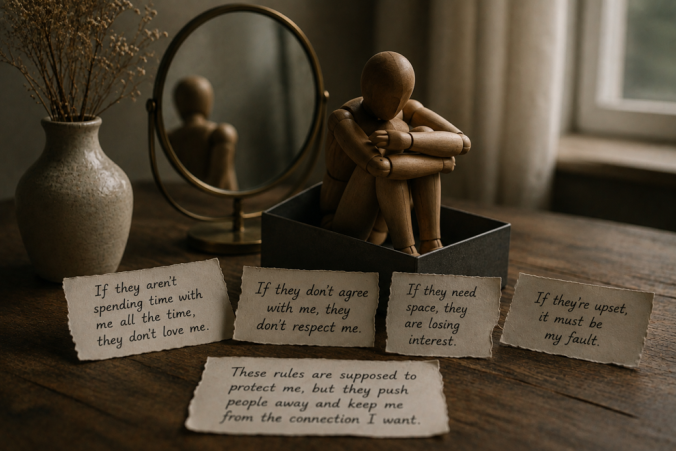
Your mind understands the problem. Your nervous system still believes the old rules.


The Hidden Weight of Inherited Armor

Family systems teach children:

  • what earns love
  • what threatens connection
  • what emotions are allowed
  • who they must be
  • what role they must play

These lessons become identity:

  • “I’m responsible for keeping the peace.”
  • “My needs are too much.”
  • “I have to be perfect.”
  • “I can’t trust closeness.”
  • “I’m only valuable when I’m helping.”

These roles follow you into adulthood even when they hurt you.

When you experience tension or criticism in a current connection, your mind doesn’t see a minor, modern disagreement. It senses the historical emergency of your past. Your old survival armor gets thrown on automatically, causing you to focus entirely on what is wrong with you, while completely losing sight of the actual, unfair reality of the relationship in front of you.


So How Do You Actually Change These Patterns?

Awareness is the first step. But lasting change comes from working with the nervous system, not against it.

Here’s how:

1. Notice the physical shift in your body without judgment

  • Before the behavior happens, your body reacts: tension · shutdown · panic · urgency · guilt · fear
  • Change begins with noticing the physical cue.
  • Practice sitting with that physical discomfort as an observer, naming the feeling without evaluating or judging it as a personal defect

2. Name the role you’re slipping into

Ask yourself:

  • Who am I becoming right now?”
  • “Is this my old family role showing up?”

Naming the role creates distance and interrupts the automatic slide into old relational positions.

3. Separate Your Actions From Their Projections

  • Notice the blame‑spiral. When someone unsafe or hyper‑critical attacks you, your mind automatically collapses into taking 100% responsibility.
  • Run a “reality split.”
    • Column 1: Write down your actual behavior – only the facts, no emotional insults, no character judgments.
    • Column 2: Write down the reality of the person criticizing you – their history of control, reactivity, manipulation, or chronic dissatisfaction.
  • Let the visual contrast interrupt the pattern. Seeing the two columns side‑by‑side stops your mind from erasing their harmful behavior and placing all the blame on you.
  • Choose your response from clarity, not collapse. Once the projection is separated from the truth, you can respond based on what actually happened rather than what they accuse you of.

4. Connect the moment to your values

Instead of fighting the urge, ask:

  • What matters most right now?”
  • What kind of relationship do I want to build?”

Values guide change more effectively than willpower.

5.  Practice Micro-Moments of Slowing Down

  • Recognize the speed of the pattern. Old relational patterns run on survival energy . They move faster than conscious thought and push you into fixing, soothing, or managing others immediately.
  • Interrupt the impulse with a physical pause. Before replying to a demanding text, stepping into someone’s bad mood, or taking on responsibility, commit to a brief slowdown.
  • Use your body to create the pause.
    • Take two slow, deep exhalations to send a direct safety signal to your nervous system.
    • Let your shoulders drop or unclench your jaw to shift out of urgency.
  • Let the pause create choice. This micro‑deceleration forms a small wedge of space between your automatic caretaking reflex and a response aligned with your actual values.
  • Respond from intention, not activation. Once your body slows down, you can choose what’s truly yours to carry instead of reacting from old conditioning.

6. Practice new behaviors in small, safe ways

Examples:

  • saying a need out loud
  • taking a moment before jumping in to help
  • tolerating silence
  • letting someone else solve a problem
  • setting one small boundary

Your nervous system learns through repetition.

7. Normalize the pull of old patterns

  • You’re not failing, you’re rewiring years of conditioning.
  • It’s normal to feel the old pattern tug at you even while you’re growing.
  • Progress is measured in awareness and micro‑shifts, not instant transformation.

The Goal Isn’t to Erase Your Old Patterns; It’s to Expand Your Choices

Healing from inherited relationship dynamics doesn’t mean your memories disappear or that you will never feel the pull of old habits again. True emotional flexibility means learning how to carry the temporary discomfort of an old pattern without letting it dictate your boundaries or wipe out your self-worth. You can feel the pull of an old pattern… and still choose differently. You can feel fear… and still set a boundary. You can feel guilt… and still honor your needs. You can feel longing… and still leave a harmful relationship.

Awareness opens the door. Practice walks you through it. Values keep you moving forward.

Many relationship patterns don’t come from “bad choices,” they come from the nervous system. You learned these patterns in childhood, long before you had words for them.

This is why you can understand exactly why you struggle… and still feel pulled into the same cycles. Your mind knows the pattern. Your body remembers the role you had to play.

Healing isn’t about forcing yourself to “do better.” It’s about learning to work with your nervous system so you can choose differently, even when the old pattern shows up.

When you understand your inherited relational patterns and learn to work with your nervous system, you gain something powerful:

Choice.


Final Thoughts

Relational healing is not about fixing another person.  It’s about reclaiming your voice, your worth, and your emotional space. When you start paying attention to what hurts, what feels off, or what you’ve been tolerating, you’re already moving toward change.

Whether you’re untangling old patterns or trying to understand what you need now, remember: you’re allowed to choose relationships that feel steady, reciprocal, and safe. You’re allowed to outgrow what no longer supports you. And you’re allowed to begin again.


Ready to Begin?

If you are ready to start therapy or have questions about working together, I would love to connect with you.

3523108470

Send Email

When You’re Waiting to “Fall Out of Love”: Why Feelings Don’t Have to Disappear Before You Choose What’s Best for You

When a relationship no longer serves your well-being, the standard advice you will hear from well-meaning friends is simple: “Just walk away.” But anyone who has ever tried to untangle themselves from a dysfunctional interpersonal dynamic knows that executing that decision is rarely a neat, linear process.

Instead, a common psychological trap occurs: we decide that we must wait for our feelings of love, attachment, or affection to completely vanish before we are allowed to take action. This sounds reasonable. It even sounds responsible. We tell ourselves that once the love is gone, leaving or staying away will feel effortless.

In clinical frameworks like Acceptance and Commitment Therapy (ACT) and Cognitive Behavioral Therapy (CBT) ), we see this exact same loop happen inside our internal worlds. People often hold their life goals, boundaries, and values on pause, waiting for their anxiety, fear, or self-doubt to disappear entirely before taking a step forward.

But the mind does not work that way. Waiting for an emotion to leave before changing your behavior is a recipe for staying stuck in relationships that are misaligned with our values, needs and long-term wellbeing.

Love doesn’t always disappear on schedule.
Missing someone doesn’t always mean you should go back.
And emotional attachment doesn’t always match the reality of the relationship.


The Myth of the Emotional Green Light

In ACT, we understand that human emotions do not operate on a simple on-off switch. Detaching from someone you have shared history with takes time, often a long time. It is a biological reality that feelings of love, chemistry, and attachment can persist long after your cognitive mind has realized that a relationship is unsafe, unequal, or draining.

If you are waiting for a complete absence of love before you enforce a boundary, end a connection, or maintain a necessary separation, you are giving your feelings total control over your life choices.  However,  feelings are not reliable indicators of readiness. They are indicators of history, bonding, habit, and human attachment.

Choosing to step away from a relationship that doesn’t serve you while you still care about the person is one of the hardest things a human being can do. It requires you to sit with a deep, internal contradiction:  “I love this person, AND staying connected to them compromises my peace and growth.”


Tolerating the Weight of Missing Someone

A major roadblock in relational healing is how we interpret the heavy sensation of missing someone. When that sudden wave of grief or longing hits you on a quiet evening, a common CBT automatic thinking error occurs. Your mind interprets the feeling as data, creating an emotional reasoning loop: “Because I miss them so intensely, it must mean I made the wrong choice. Missing them means we belong together.”

This is where we must apply a core ACT principle: Missing someone is just an emotion. It is not an instruction manual.

Feeling a deep ache of longing for a former partner or a family member does not mean you should be with that person. It is not a contradiction to your chosen path. Missing someone is simply the natural price we pay for having an attachment history. It is proof that you cared, not proof that you should reverse a healthy boundary.


Love and Attachment Are Not the Same as Alignment

True emotional flexibility means building the capacity to carry two opposing realities at the exact same time. You can deeply miss a person, you can still feel a lingering pull of love toward them, and you can choose to keep your distance because that choice aligns with your core values and long-term goals for your life.

Healing doesn’t mean your mind stops generating memories or longings. Healing means those feelings no longer have the power to dictate your behavior. You are allowed to take care of yourself, step into a healthier routine, and build a peaceful life even while you are waiting for the rest of your heart to finally catch up.

ACT and CBT helps us see that:

  • Love does not automatically equal compatibility.
  • Missing someone does not automatically equal “go back.”
  • Attachment does not automatically equal “stay.”

Choosing Based on Values Instead of Waiting for Feelings to Change

ACT encourages committed action: taking steps toward your values even when your emotions are loud.

CBT encourages cognitive flexibility: recognizing that thoughts and feelings are not instructions.

Together, they support a different kind of clarity:

  • You do not have to wait for love to fade before you leave.
  • You do not have to wait for missing to stop before you move forward.
  • You do not have to wait for attachment to dissolve before you choose yourself.

You can act based on:

  • your values
  • your needs
  • your boundaries
  • your long‑term wellbeing

And let your feelings catch up over time.


Final Thoughts

If you are navigating this right now, it is normal to feel conflicted. It is normal to feel pulled in two directions. It is normal to feel love and still know the relationship is not right for you.

You are not weak for feeling attached. You are not confused for missing someone. You are not wrong for wanting clarity.

You are human.

And you can choose what aligns with your values even when your emotions are still shifting.


Ready to Begin?

If you are ready to start therapy or have questions about working together, I would love to connect with you.

3523108470

Send Email

Sidebar