Self-Worth, Anxiety & Relationship Patterns Therapy in Florida

Tag: anxiety

When You Learn to Read the Room: How Childhood Experiences Shapes Adult Relationships

Some children learn to read the room before they learn to read words. They notice the sigh before the argument, the silence before the storm, the subtle shift in tone that means something is wrong. They adapt quickly, quietly, and often voluntarily not necessarily because anyone told them to, but because it made things feel safer.

“If I can anticipate someone’s mood, I can prevent something bad from happening.” “If I know when someone is upset, I can adjust myself.” “If I keep everyone emotionally regulated, things feel safer.”

For some children, this is where emotional responsibility begins. For others, emotional monitoring itself becomes a way of staying safe. Either way, the child learns that paying close attention to other people’s emotions can help create a sense of predictability or security.


The Origins of Emotional Monitoring

Emotional monitoring is the habit of constantly scanning other people’s moods, reactions, and emotional states in order to anticipate what might happen next. When a child learns that the emotional climate around them can change quickly, paying attention becomes a way of staying prepared.

For some, this pattern begins in environments where emotions are unpredictable, conflict is frequent, or the child has experienced frightening or traumatic situations. For others, it develops through inconsistent caregiving, emotional unavailability, or unmet emotional needs. A child may also become highly attuned to others when they are expected to soothe, support, or manage a parent’s emotions.

Sometimes there is no obvious crisis. A child may simply learn that staying attuned to other people’s moods helps maintain connection, reduce tension, or avoid disappointment. What begins as adaptation can eventually become a deeply ingrained way of relating to others.

This adaptation can look mature, empathic, or even gifted.  But underneath, it can involve a level of vigilance that makes it difficult to simply be present in relationships.


The Child Who Reads the Room

The child who learns to read the room can become the family’s emotional thermostat.  They learn to sense when someone is irritated before anyone says it. They notice subtle changes in tone, posture, or silence. They replay conversations to see if they caused distress. They adjust their personality depending on who they are with. They take on the invisible job of keeping everyone emotionally comfortable.

This is not about attention‑seeking. It is about safety. When the emotional climate feels unpredictable, the child’s nervous system learns that stability depends on their awareness and response.


How It Shows Up in Adulthood

That early vigilance often becomes a relational reflex. You may:

  • Notice subtle changes in someone’s tone immediately
  • Overanalyze texts and facial expressions
  • Sense irritation before anyone says it aloud
  • Immediately wonder, “Did I do something?”
  • Replay conversations looking for signs you upset someone
  • Feel uneasy when someone is quiet
  • Assume a change in mood has something to do with you
  • Try to fix tension before anyone asks you to
  • Overthink what to say to avoid triggering a reaction
  • Feel responsible for keeping interactions comfortable
  • Struggle to relax around emotionally unpredictable people
  • Automatically adjust your personality depending on who you’re with
  • Lose track of your own feelings because you’re focused on everyone else’s
  • Mistake awareness of someone’s emotions for responsibility for their emotions

This pattern can overlap with parentification and relational guilt. Parentification describes a childhood role in which a child takes on responsibilities that belong to adults. Relational guilt can involve feeling responsible for other people’s emotions, comfort, or reactions. Emotional monitoring can connect with both when a child learns to constantly scan, anticipate, and adjust to the emotional environment around them.


The Cost of Constant Awareness

Emotional monitoring can make relationships feel like performance. You may feel like you are always managing the emotional temperature, always adjusting, always preventing something. It can lead to exhaustion, anxiety, and difficulty trusting that others can handle their own emotions.

You might confuse empathy with responsibility. You might believe that noticing someone’s discomfort means you must fix it. You might feel guilty for relaxing when others are tense. You might struggle to identify your own feelings because your attention is always outward.

This may look like a boundary problem in adulthood, but underneath it can be a learned reflex.


The Therapeutic Shift

The goal is not to become less caring or less perceptive. It is to recognize that noticing something does not automatically make it yours to manage.

You can notice someone’s mood without taking responsibility for it. You can sense tension without needing to fix it. You can care about someone’s feelings without absorbing them.

This shift is subtle but profound. It teaches your body that safety no longer depends on managing everyone else’s emotional state. It allows empathy to coexist with boundaries. It transforms vigilance into attunement.


Relearning Emotional Safety

In therapy, this often looks like:

  1. Recognizing the pattern Naming emotional monitoring helps you see it as adaptation, not identity.
  2. Rebuilding internal permission You are allowed to notice without intervening. You are allowed to rest even when others are uneasy.
  3. Practicing emotional neutrality When someone’s mood changes, pause before assuming it is about you. Ask yourself, “What am I noticing, and what am I assuming?” Then ask, “Is this mine to carry?”
  4. Reconnecting with your own feelings Awareness of others often comes at the cost of awareness of self. Healing restores that balance.
  5. Learning to tolerate tension Discomfort does not always mean danger. Sometimes it is simply difference.

Final Thoughts

Emotional monitoring is a skill born from necessity. It kept you safe when safety depended on emotional awareness. But now, it may keep you anxious when safety depends on self‑trust.

You can still read the room; you just do not have to hold it together. You can still care deeply; you just do not have to carry it all. You can still be attuned; you just do not have to be responsible.

The goal is not to stop noticing. It is to stop absorbing.

When Self‑Evaluation Takes Over: How Overthinking Pulls Us Away From What Matters

Most adults who struggle with self‑doubt, people pleasing, or perfectionism don’t realize how often they are evaluating themselves. Not reflecting, not observing but evaluating. Over‑evaluation is the constant measuring, judging, and scoring of your worth, choices, performance, or emotional experience. It’s subtle, automatic, and often feels like “just being responsible,” but it quietly pulls you away from the life you want to live.


What Over‑Evaluation Looks Like

Over‑evaluation shows up in small, everyday moments:

  • replaying conversations to see if you sounded “off”
  • checking whether you did enough, helped enough, or were enough
  • comparing your productivity to others
  • judging your emotional reactions as good or bad
  • scanning for mistakes instead of noticing what went well
  • rethinking decisions you need to make, analyzing every option until you feel stuck or unsure how to move forward
  • worrying about how you were perceived instead of how you felt

It’s the mental habit of constantly asking “How did I do?” and “How will I do?” instead of “What matters here.”

From an ACT perspective, over-evaluation can involve cognitive fusion, becoming so caught up in our thoughts that they begin to feel like instructions, facts, or rules we have to follow.


Why We Learn to Over‑Evaluate

Over‑evaluation often comes from experiences where your value felt tied to:

  • being capable
  • being responsible
  • being easy to love
  • being helpful
  • being emotionally contained
  • being high achieving

But it doesn’t only come from childhood or early environments. Over‑evaluation can also grow out of:

  • stressful or overwhelming adult experiences
  • moments where you felt judged or misunderstood
  • periods of burnout or chronic pressure
  • regrets you haven’t fully processed
  • mistakes that felt defining or hard to move past

These experiences can make you feel like your worth depends on getting things right, staying in control, or avoiding future missteps. Over time, evaluation becomes a protective habit, a way to prevent more stress, disappointment, or regret even though it ends up pulling you away from valued living.

This pattern often shows up alongside perfectionistic pressure. I explore that more in my Practice Imperfection blog.

When your worth feels connected to performance or approval, evaluation becomes a survival strategy. You learn to monitor yourself closely to avoid criticism, disappointment, or conflict. Over time, this becomes automatic, a background process running all day long.

From an ACT perspective, this can reflect fusion with a self-story: “I’m only valuable if I perform well.


How Over‑Evaluation Pulls You Away From Valued Living

Valued living is acting in alignment with what matters most to you, your relationships, your integrity, your growth, your wellbeing. Over‑evaluation disrupts this in several ways:

1. It keeps you focused on performance instead of presence.

You’re in the room, but you’re not in the moment. You’re monitoring yourself instead of experiencing your life. This is the opposite of present‑moment awareness.

2. It makes decisions based on fear instead of values.

You choose what feels safest, not what feels meaningful. From an ACT perspective, this can involve experiential avoidance, choosing what feels safer or more comfortable in the short term rather than moving toward what matters to you.

3. It shrinks your willingness to try new things.

If everything is a test, everything becomes risky. This reduces willingness, a core ACT process.

4. It reinforces the belief that your worth is unstable.

Even though your self‑worth does not change, over‑evaluation makes it harder to feel connected to it. This is fusion with the “not enough” story.

5. It creates emotional exhaustion.

Constant self‑monitoring drains your attention, energy, and confidence.


The Shift: From Evaluation to Awareness

The opposite of over‑evaluation is not indifference. It’s awareness, noticing your experience without scoring it.

Awareness sounds like:

  • “I felt anxious in that meeting.”
  • “I was trying really hard to get it right.”
  • “I cared about how I came across.”
  • “I’m feeling pressure to perform.”

Judgment sounds like:

  • “I shouldn’t feel anxious.”
  • “I messed that up.”
  • I should have handled that better.”
  • “People probably think I’m incompetent.”
  • “I need to stop being so emotional.”
  • “I always make things harder than they need to be.”
  • “I should be doing more.”

Awareness gives you information. Evaluation gives you judgment.

Awareness helps you choose your next step based on values. Evaluation keeps you stuck in fear of missteps.

This shift is ACT’s movement from fusion to defusion, seeing thoughts as thoughts, not commands.


Practicing Valued Living Instead of Over‑Evaluation

Here are gentle ways to shift out of evaluation and back into what matters:

  • Notice when you start scoring yourself.
  • Ask, “What matters most in this moment?”
  • Let your values guide your next action.
  • Allow yourself to be human instead of perfect.
  • Practice doing things imperfectly on purpose.
  • Slow down enough to feel your internal experience.

Valued living is not about performing well. It’s about showing up in ways that align with who you want to be.

This is ACT’s core: values‑based action in the presence of discomfort.


Final Thoughts

If you’ve spent years evaluating yourself, it can feel unfamiliar, even unsafe to live from your values instead of your fears. Over‑evaluation is a habit shaped by old pressures, old expectations, and old stories about who you needed to be and what you believed you had to do to be worthy.  But those stories are not the same as your identity.

As you practice awareness, defusion, and values‑based action, you begin to reconnect with a steadier sense of self. You learn to let thoughts be thoughts, feelings be feelings, and choices be guided by what matters most to you.

Living becomes possible again, not as a performance, but as a meaningful, values‑aligned experience.

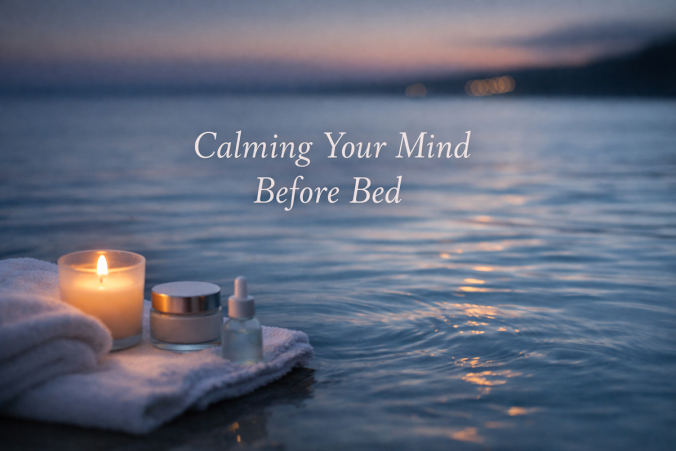
When Your Mind Won’t Turn Off at Night

You finally get into bed. The room is quiet. Your body is tired. And then your mind decides it is the perfect time to replay conversations, plan tomorrow, or worry about things you cannot control.

If this sounds familiar, you are not alone. Many of my clients in Gainesville and throughout Florida function well during the day struggle with racing thoughts at night. Your mind is not trying to sabotage you. It is trying to process everything you did not have space to feel earlier.

Let’s talk about why this happens and what you can do to calm your mind before bed.

1. Your brain finally has space to think

During the day, you are busy. You are working, helping, planning, or managing. Your mind stays in problem solving mode. At night, when everything slows down, your brain finally has room to release the thoughts it held back.

This is why the quiet feels loud.

2. Your nervous system is still activated

Even if your body is tired, your nervous system may still be in alert mode. Stress, pressure, and emotional overload keep your system wired long after the day ends.

Your mind is not overreacting. It is trying to protect you.

If your mind stays busy even when your body is tired, you may also like my post on Why It’s So Hard to Slow Down.

3. You are carrying emotional weight you did not notice

When you stay busy, you do not always feel your feelings in real time. At night, the emotions you pushed aside rise to the surface. This is not a sign of weakness. It is a sign that your mind is asking for attention.

4. You are used to being the responsible one

If you are the person who holds everything together, your brain may believe it has to stay alert. Letting go at night can feel unfamiliar or unsafe.

You are not doing anything wrong. You are human.


How to Calm Your Mind Before Bed

These small shifts can help your mind settle without forcing yourself to relax.

1. Do a brain dump before bed

Write down everything on your mind. Tasks, worries, reminders, thoughts. Your brain relaxes when it knows things are stored somewhere safe.

2. Use a gentle transition routine

Your mind needs a bridge between day mode and rest mode.
Try a warm shower, soft stretching, dimming the lights, or my favorite, my skincare routine.
Turn off all blue light and get off your phone and TV at least an hour before bed so your brain has time to settle.

3. Slow your breathing, not your thoughts

You do not have to stop thinking. Just slow your breath. Your mind will follow your body.

4. Give your thoughts a place to go

If your mind is busy, tell yourself: I can think about this tomorrow. This simple sentence gives your brain permission to pause.

5. Practice compassion, not control

You do not have to force your mind to be quiet. You only need to give it a softer place to land.


Final Thoughts

If your mind will not turn off at night, it does not mean you are broken or failing. It means your nervous system has been working hard for a long time. With small, consistent changes, you can teach your mind and body how to settle.

If you’re noticing how hard it is to shift out of “go mode,” therapy can help you understand what your nervous system is doing and how to create more ease in your day. You can learn more about the support I offer on my Services & Rates page.


Ready to Begin?

If you are ready to start therapy or have questions about working together, I would love to connect with you.

3523108470

Send Email

Why It’s So Hard to Slow Down (Even When You Want To)

Most adults don’t struggle because they are bad at relaxing. They struggle because their nervous system has learned that slowing down feels unsafe, unfamiliar, or unproductive, even when they are exhausted.

If you’ve ever wondered why it’s so hard to slow down, even when you’re exhausted, you are not alone. This is one of the most common patterns I see in therapy  adults in Gainesville and across Florida.

Let’s talk about why this happens and what you can do about it.

1. Your brain thinks staying busy keeps you safe

For many people, staying in motion became a survival strategy early in life. Being productive, helpful, or on top of things may have been the way you avoided criticism, conflict, disappointment or to people please.

So now, when you try to slow down, your brain sends a quiet alarm. Something feels off. Get up. Do something.

It is not a flaw. It is conditioning.

2. Rest can feel unfamiliar, not relaxing

If you have spent years or decades pushing through stress, your body may not recognize rest as rest. Stillness can feel:

  • uncomfortable
  • boring
  • vulnerable
  • like you are wasting time

Your nervous system needs time to learn that slowing down is safe.

3. You are carrying invisible emotional weight

When you finally stop moving, all the thoughts and feelings you have been holding back rise to the surface. This is why many people feel more anxious at night or on weekends.

It is not that you cannot relax. It is that your mind finally has space to speak and this space is important.

If nights or weekends are especially hard, you may find my post on When Your Mind Won’t Turn Off at Night helpful.

4. You have been praised for being the strong one

If people rely on you, admire your resilience, or see you as the responsible one, slowing down can feel like you are letting someone down.

You are not. You are human.

5. Your body is stuck in go mode

Chronic stress keeps your nervous system in a heightened state. Even when the stressor is gone, your body does not automatically shift into calm.

This is why rest feels like a skill, not a default.


How to Start Slowing Down Without Feeling Overwhelmed

These are small, realistic steps that help your nervous system adjust gently.

1. Start with micro pauses

Ten to twenty seconds of slowing down is enough to begin retraining your system. A breath. A stretch. A moment of noticing your surroundings and then continue to build from there.

2. Replace rest with reset

Sometimes the word rest feels too passive. Reset feels purposeful, and your brain may accept it more easily.

3. Let your body lead

Instead of forcing yourself to relax, ask: What would feel two percent softer right now? A slower breath. A gentler tone. A relaxed shoulder.

4. Practice gratitude in motion

If stillness feels too hard, try gratitude while walking, cleaning, or driving. It shifts your nervous system without requiring you to stop.

5. Give yourself permission to be human

You do not have to earn rest. You do not have to justify it. You do not have to be productive to deserve peace.


Final Thoughts

If slowing down feels hard, it does not mean you are broken. It means your nervous system has been working overtime for a long time. With small, consistent shifts, your body can learn a new rhythm.

Therapy can help you understand your patterns, reconnect with yourself, and create a calmer internal world.  You can learn more about my services on my Services & Rates page


Ready to Begin?

If you are ready to start therapy or have questions about working together, I would love to connect with you.

3523108470

Send Email

Sidebar