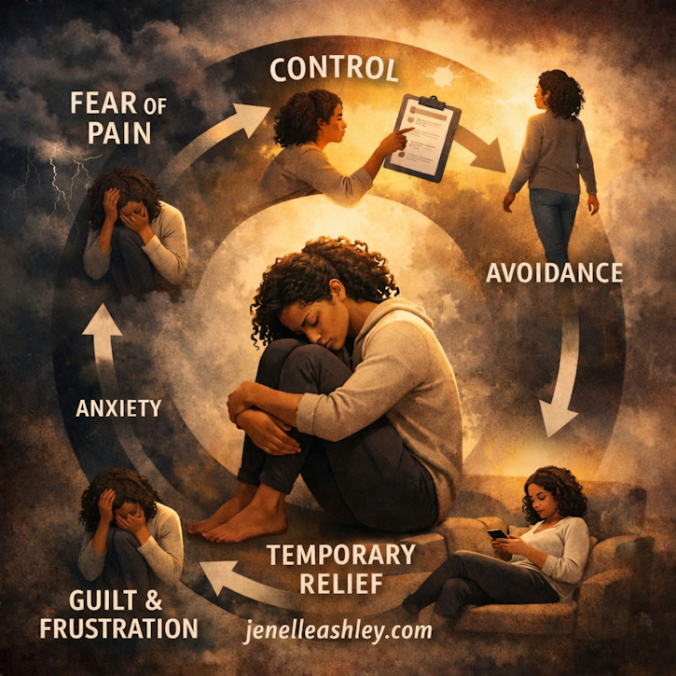
In our last post, we explored how trying to maintain constant control over your life is a logical survival mechanism, but one that ultimately leaves you running on empty. When you are used to wearing heavy armor, your mind becomes highly efficient at over-thinking, over-preparing, and people-pleasing just to keep emotional discomfort at bay.
Acknowledging that your survival armor is exhausting is the first step. The next question is practical: How do you actually begin to safely lower your guard in your daily life?
When your nervous system has been stuck in “go-mode” for years, you cannot simply force yourself to suddenly relax. Healing requires small, intentional, and repeatable shifts to show your body that it is safe to slow down.
Here are three practical steps to help you interrupt the cycle of control and begin building lasting internal ease.
1. Shift to Observing Mode
When anxiety spikes, your mind immediately goes into hyper-drive trying to fix, predict, or manage the situation. This is emotional avoidance in action. Instead of fighting the anxious thoughts or trying to force them away, try to simply name what is happening without judging it.
- The Practice: The next time you feel your body tense up over an unpredictable schedule change or a minor mistake, pause and mentally say to yourself: “I am noticing that my mind is playing the perfectionism tape right now.” Or, “I am noticing that my chest feels tight and my system wants to take total control.” That’s it no evaluation.
- The Shift: By changing your language from “I am completely overwhelmed” to “I am noticing that I am experiencing overwhelm,” you step out of the storm and into the role of the observer. This small bit of mental distance stops the overthinking loop from taking over your entire afternoon.
2. Audit Your Rigid Mental Rules
High-functioning burnout is heavily fueled by automatic, rigid “Should” and “Must” rules we subconsciously place on ourselves. Rules like: “I must be the reliable person for everyone else,” or “If I don’t handle this perfectly, it means I am failing.” These rules act as invisible walls that keep you trapped in non-stop over-functioning.
- The Practice: Pick one area of your life this week where you feel immense pressure. Write down the underlying rule driving that behavior. Ask yourself: Where did this rule come from? Is it keeping me safe, or is it leaving me running on empty?
- The Shift: Gently rewrite that rigid rule into a flexible, self-compassionate alternative. Change “I must handle everything myself or I am incompetent” to “I am a capable person, but I am also allowed to have human limits and ask for support.”
3. Practice Deceleration
If you are trapped in a non-stop hustle culture loop, jumping straight into a 30-minute meditation can feel incredibly frustrating and jarring to a hyper-vigilant nervous system. Instead, practice micro-moments of slowing down to show your brain that stopping does not equal danger.
- The Practice: Choose one ordinary daily task like drinking your morning coffee, sitting in your car before typing an email, or washing your hands and do it at half-speed. For just 60 seconds, pay complete attention to the physical sensations: the warmth of the mug, the sound of the room, or the feeling of your feet flat on the floor.
- The Shift: These small physical anchors send a direct safety signal to your brain stem, gently pulling your nervous system out of an anxious future and anchoring it securely back into the peaceful present.
Final Thoughts
Learning how to safely lower your guard when you have relied on armor for years is not a linear process. It takes time, patience, and a willingness to step outside your comfort zone. If your system resists these changes at first, remember that your need for control has protected you from real pain, rejection, or structural burnout in the past.
True emotional flexibility is not about achieving perfect mindfulness; it is about building a gentle, curious relationship with your own internal patterns. You do not have to figure out how to unburden the past or navigate these protective loops all by yourself.
If you are ready to move out of survival mode and build genuine emotional flexibility, a supportive and collaborative therapeutic space is ready for you. I provide specialized individual telehealth for adults anchoring across Gainesville, Jacksonville, and all of Florida. You can view my active booking calendar, structural credentials (CCTP, MCAP), and transparent private-pay options directly on my Services & Rates page.
Ready to Begin?
If you are ready to start therapy or have questions about working together, I would love to connect with you.